
Introduction
The origin story of a software project tells you more about its future than any feature list. It tells you whether the creator was solving a real problem or chasing a market. It tells you whether the community formed around genuine enthusiasm or manufactured hype. And it tells you whether the project has the structural foundations — governance, licensing, contributor culture — to outlast its founding circumstances.
OpenClaw’s origin story is worth understanding in full. It starts with a one-hour experiment by a retired developer on a November evening in 2025. It ends, four months later, with a 309,000-star GitHub repository, a Tencent integration inside WeChat, a security panic across four continents, and its creator joining OpenAI while the project he built transitions to an independent foundation.
This guide documents the complete chronological history of OpenClaw — every name, every rebrand, every milestone, and every inflection point — drawn from primary sources including the official OpenClaw blog, Wikipedia, CNBC, the official GitHub release notes, and contemporaneous reporting from the Taskade team, SimilarLabs, and 36Kr’s English edition.
Want to understand what OpenClaw does today? → [What Is OpenClaw AI? Everything You Need to Know]
When Was OpenClaw First Created?
The initial version of what became OpenClaw was built in a single hour one night in November 2025, by Austrian developer Peter Steinberger. The concept was modest: could an AI assistant remotely monitor computer activity through a chat app?
Steinberger had previously founded PSPDFKit — a PDF SDK company later acquired by Insight Partners — and had spent approximately three years after the sale traveling, hosting parties, and living across different countries. He had returned to active development in 2025 with a specific insight: purpose cannot be found — it must be created.
The first version took one hour to build. Steinberger connected WhatsApp to Anthropic’s Claude via a simple script. Send a message to a WhatsApp number, and Claude would respond. Ask it to check your email, and it would. The code was rough, but the concept was electrifying.
At the time, Steinberger believed the idea was so obvious that large technology companies would inevitably build equivalent products — so he treated it as a small personal tool. OpenAI did not build it. Google did not build it. Anthropic did not build it either. The “small toy” began its own journey.
The initial private codebase was named Clawd — a portmanteau of “Claude” and “claw.” The space lobster mascot, now globally recognisable as Molty, was born at the same time.
When Was OpenClaw Released to the Public?
The project was originally published in November 2025 by Peter Steinberger under the name Clawdbot. The software was derived from Clawd, an AI-based virtual assistant he had developed, which was itself named after Anthropic’s chatbot Claude.
The public release under the name Clawdbot — with the repository live on GitHub and available for anyone to clone and run — happened in late November 2025. At the time of release, the codebase already included the core architecture that defines OpenClaw today: a persistent Gateway daemon, a messaging channel layer (initially supporting WhatsApp and Telegram), a SOUL.md personality configuration file, and a basic skills system.
By early January 2026, Clawdbot had become a viral sensation among developers, who were impressed by its ability to execute bash commands, manage emails, and coordinate multi-step workflows across WhatsApp, Discord, and Slack. It was the first time that “agentic AI” felt accessible to the average developer without a massive cloud bill.
At this stage, the project was still fundamentally a one-person engineering effort. Steinberger’s daily routine, as documented by 36Kr’s English edition, was to collect community feedback overnight, start writing code at 6 AM, and release a new version by noon. This shipping velocity — multiple meaningful releases per week — was one of the primary drivers of early community growth.
When Was OpenClaw Officially Launched?
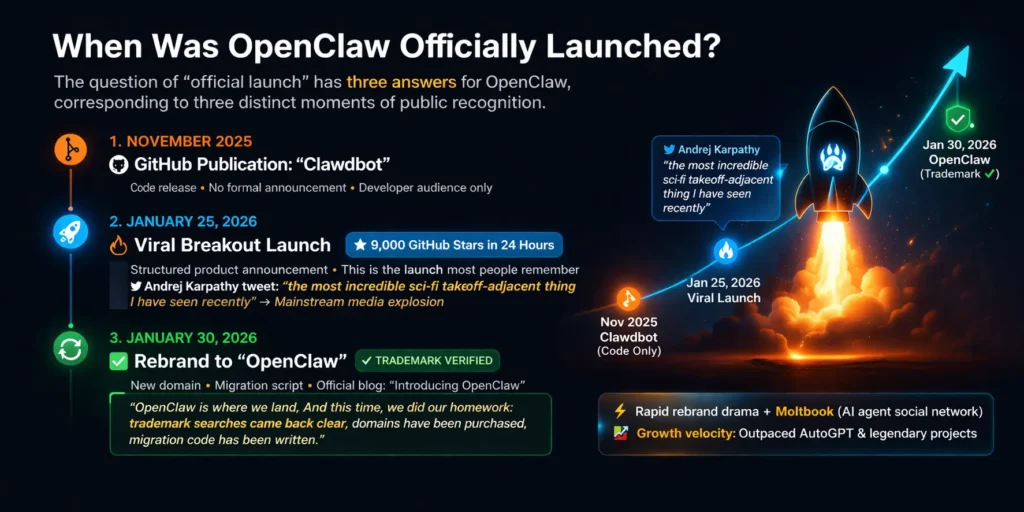
OpenClaw Version History — Major Milestones
The following timeline reconstructs the project’s key moments from primary sources. Version numbers follow the OpenClaw YYYY.M.DD datestamp format used throughout its release history.
| Date | Name / Version | Key Development |
|---|---|---|
| November 2025 | Clawd (private) | First working prototype built in one hour. Clawd connects WhatsApp to Claude API. Personal tool only. |
| Late November 2025 | Clawdbot v0.1 (public) | First GitHub publication. Core architecture: Gateway daemon, WhatsApp/Telegram channels, SOUL.md, basic skills. |
| December 2025 | Clawdbot (growing) | Community skills ecosystem begins forming. Discord, iMessage, and browser control skills added. First 10,000 GitHub stars. |
| Early January 2026 | Clawdbot (viral breakout) | Developer viral growth begins. Andrej Karpathy endorsement. GitHub stars surpass 50,000. Heartbeat system introduced. |
| January 25, 2026 | Clawdbot (official product launch) | Structured product announcement. 9,000 stars in one day. First mainstream media coverage. |
| January 27, 2026 | Moltbot | Anthropic trademark request received. Emergency rebrand decided in a 5 AM Discord brainstorm. Project renamed Moltbot. Handle theft on X occurs during the transition; fake $CLAWD token on Solana briefly reaches $16 million market cap before collapsing. |
| January 28, 2026 | Moltbot | Moltbook social network for AI agents launches, created by Matt Schlicht. Tencent Cloud and Alibaba Cloud launch one-click deployment solutions for Moltbot. |
| January 30, 2026 | OpenClaw | Final rebrand. The name “OpenClaw” passes trademark searches. New domain (openclaw.ai) live. Migration code ships. Official “Introducing OpenClaw” blog post published. |
| February 2, 2026 | OpenClaw | CNBC publishes “From Clawdbot to Moltbot to OpenClaw.” GitHub stars pass 145,000. First mainstream enterprise media coverage. |
| February 6–7, 2026 | v2026.2.6 | VirusTotal partnership announced. VirusTotal Code Insight integrated for skill security scanning. Web UI token usage dashboard added. |
| February 8, 2026 | OpenClaw | Censys data shows 30,000+ publicly exposed instances. SecurityScorecard subsequently identifies 135,000 exposed instances across 82 countries. |
| February 12, 2026 | v2026.2.12 | Over 40 vulnerability fixes shipped in a single release. ClawJacked (CVE-2026-25253, CVSS 8.8) patched within 24 hours of disclosure. |
| February 14, 2026 | OpenClaw (Foundation) | Peter Steinberger announces he is joining OpenAI. Project transitions to an independent open-source 501(c)(3) foundation with OpenAI sponsorship. OpenAI’s Sam Altman describes Steinberger as “a genius with a lot of amazing ideas.” |
| February 26, 2026 | v2026.2.26 | Latest stable release. Hardened default network binding. HTTP security headers (HSTS). Browser SSRF policies. Dedicated security advisor (Jamieson O’Reilly) joins project. |
| March 2, 2026 | OpenClaw | GitHub stars reach 247,000. Forks: 47,700. Contributors: 1,000+. Surpasses React as most-starred software repository on GitHub. |
| March 6, 2026 | OpenClaw | Tencent hosts public OpenClaw installation event at its Shenzhen headquarters. Nearly 1,000 people queue outside. “National crayfish-raising” phenomenon declared in Chinese tech media. |
| March 9–10, 2026 | OpenClaw | Tencent launches QClaw (OpenClaw-based agent) and WorkBuddy. Tencent Cloud reports 100,000+ customers have deployed OpenClaw via its platform. |
| March 18, 2026 | OpenClaw / QClaw | Tencent releases updated QClaw as a WeChat mini-program (public beta). Remote PC control via smartphone chat becomes available to WeChat’s 1.3 billion monthly users. |
The Evolution of OpenClaw — From Simple Tool to Agentic AI Platform
The transformation from Clawdbot to OpenClaw is not only a naming story. It is an architectural story about how community input reshaped a one-person tool into a platform.
The Early Vision: A Personal Command Interface
Steinberger’s original question was almost laughably simple: could an AI assistant remotely check work progress on his computer through a chat app? The initial Clawd prototype answered that question in an hour. Everything that followed was the consequence of an open-source release landing at exactly the moment the developer community was ready for it.
How Community Feedback Drove Architecture
The SOUL.md personality file — one of OpenClaw’s most distinctive features — was not in the original design. It emerged from user requests for persistent identity. The Heartbeat system for proactive background tasks was a community proposal. The multi-channel architecture (supporting 20+ messaging platforms) grew from individual contributors submitting channel adapters for Signal, iMessage, Discord, Slack, and Nostr.
Steinberger framed pull requests as “Prompt Requests,” noting that many contributors who had never previously submitted code to an open-source project participated in OpenClaw’s development. The community broadened not just the feature set but the contributor base.
The Clawdbot Era: Developer Tool
From November 2025 to late January 2026, OpenClaw was primarily a developer tool. Setup required genuine technical literacy. The documentation was sparse. The skill ecosystem was small. The users were software engineers who could tolerate rough edges in exchange for genuine capability.
The Viral Moment: A Category Shift
The January 25 product announcement triggered a category shift. The project stopped being “a cool tool developers are sharing” and became “the thing everyone is talking about.” Within 72 hours of the announcement, it had 60,000 GitHub stars. By March, it surpassed React to become the most-starred software project on GitHub at 250,000+ stars.
This shift in audience created pressure: new users arrived with different expectations, lower technical tolerance, and genuine security risks if they misconfigured their deployments. The security incidents of February 2026 were the direct consequence.
The Foundation Era: Community Ownership
The transition to an independent 501(c)(3) foundation on February 14, 2026 was the most structurally significant moment in OpenClaw’s history. Steinberger wrote at the time: “The community around OpenClaw is something magical. It will stay a place for thinkers, hackers and people that want a way to own their data.” OpenAI sponsors the project but does not own the code. The MIT licence and community governance remain intact. The foundation structure removes the licensing risk that would otherwise deter large organisations from committing to the framework.
OpenClaw and the Broader AI Timeline
OpenClaw did not emerge in isolation. Its rise coincided with, and was enabled by, three converging trends in the AI landscape between 2022 and 2026.
The LLM capability threshold: Between 2022 and 2025, large language models crossed the threshold from “impressive text generation” to “reliable instruction following and tool use.” Without Claude 3.5 Sonnet, GPT-4o, and DeepSeek V3 being capable enough to execute multi-step agentic tasks reliably, OpenClaw’s premise would not have worked. The intelligence needed to interpret natural language instructions, plan multi-step workflows, and recover gracefully from errors simply was not available in 2023.
The messaging app as operating system: Rather than asking users to adopt a new application, OpenClaw routed AI through software people already open dozens of times per day. This design decision — messaging-first, not app-first — was the key to its mainstream adoption in China, where WeChat’s ubiquity made QClaw’s immediate resonance with hundreds of millions of users structurally inevitable.
The self-hosting renaissance: By 2026, meaningful numbers of users had the technical literacy to run a Node.js process on a VPS and the privacy motivation to prefer it. OpenClaw arrived exactly when that population was large enough to form a critical mass of early adopters who then evangelised it to adjacent communities.
OpenClaw’s open-source nature has likely helped drive adoption by enabling users to build new app integrations. The IBM research scientist Kaoutar El Maghraoui stated that OpenClaw demonstrates that the real-world utility of AI agents is not limited to large enterprises and can be “incredibly powerful” when given full system access.
What’s Next for OpenClaw? Roadmap & Future Plans
The foundation transition ensures OpenClaw’s continued development is not contingent on any single individual’s availability. The community roadmap — maintained on the official GitHub repository — reflects priorities identified through community voting and contributor discussion.
Foundation Governance
The independent 501(c)(3) foundation is the primary governance body for all major architectural decisions. OpenAI provides sponsorship and resource support. Neither Tencent nor OpenAI controls the shared infrastructure — a deliberate structural choice designed to keep the framework neutral and available to all commercial and individual users equally.
OpenClaw Cloud (Coming)
A managed hosting offering — OpenClaw Cloud — is in development. This will provide a non-technical onboarding path: no VPS, no Node.js, no command line. The core open-source software will remain MIT-licensed regardless of the managed offering’s pricing. This addresses the largest current barrier to mainstream adoption.
Security Infrastructure
The VirusTotal partnership, the security advisor appointment, and the 40+ fixes in v2026.2.12 represent a deliberate security maturation phase. Upcoming work includes formal penetration testing of the skill ecosystem, improved permission sandboxing, and a consent verification system that requires explicit user approval for any write or exec action.
Chinese Ecosystem Expansion
On 10 March 2026, Tencent said it had launched a full suite of easy-to-use AI products built on OpenClaw which is also compatible with its superapp WeChat. Tencent Cloud’s one-click deployment infrastructure has already acquired more than 100,000 customers. Alibaba Cloud’s parallel offering adds equivalent scale. The Longgang District of Shenzhen has announced subsidies of up to 2 million yuan for OpenClaw-based projects — a signal of government-level recognition of the platform’s economic significance.
The “Normalisation” Phase
As Andrej Karpathy observed in an endorsement cited across media, OpenClaw is part of a deeper paradigm shift — from AI as a conversational interface to AI as an autonomous actor. The project’s roadmap, community discussions, and Steinberger’s stated direction at OpenAI all converge on the same destination: an AI agent that is genuinely safe enough for non-technical users, available through the apps they already use, and capable of running meaningful portions of a person’s digital work life without supervision.
[What Is OpenClaw AI?] — “See everything OpenClaw can do today →”
Frequently Asked Questions
Exactly when was OpenClaw first made available?
The initial private prototype (Clawd) was built in November 2025. The first public GitHub release under the name Clawdbot followed in late November 2025. The structured product announcement that drove viral growth occurred on January 25, 2026. The current name, OpenClaw, was adopted on January 30, 2026.
Has OpenClaw ever rebranded or changed its name?
Yes — three times. The project began as Clawd (private), became Clawdbot (first public release, November 2025), was briefly renamed Moltbot on January 27, 2026 following a trademark request from Anthropic, and settled on OpenClaw three days later on January 30, 2026. All three public names refer to the same continuous codebase and project.
When was the OpenClaw Gateway feature added?
The Gateway architecture — the persistent daemon that runs on your machine and manages all channel connections, model routing, and skill execution — was present in the original Clawdbot release in November 2025. It is not a feature added later; it is the foundational architecture of the project. The terminology “Gateway” and its documentation formalisation evolved through 2026 as the project grew.
Is OpenClaw still being actively developed in 2026?
Yes. The project is now governed by an independent open-source 501(c)(3) foundation with OpenAI sponsorship. As of March 2026, it has over 1,000 contributors, ships multiple updates per week, and is the most-starred software repository on GitHub. Commercial adoption by Tencent, Alibaba, Xiaomi, and other major technology companies ensures continued investment in the platform’s development.
Conclusion
OpenClaw’s history is compressed in a way that is historically unusual: from a one-hour prototype to a globally debated AI platform in four months. That compression was the product of timing — the LLM capability threshold, the developer community’s readiness, and one developer’s willingness to release early and iterate in public.
The story from Clawd to Clawdbot to Moltbot to OpenClaw is not a branding saga. It is a record of how a genuine technical insight, combined with open-source distribution and community ownership, can move faster than any corporate product roadmap. The trademark drama, the security incidents, the Tencent integration, the Foundation transition — each chapter tells you something real about what the project is, how it operates, and whether it has the structural foundations to matter long-term.
The answer, based on the evidence, is yes.
Now that you know the full story behind OpenClaw, see everything it can do for you today → [What Is OpenClaw AI? Everything You Need to Know]
Source:
- Official OpenClaw Blog — “Introducing OpenClaw”: https://openclaw.ai/blog/introducing-openclaw
- Wikipedia — OpenClaw: https://en.wikipedia.org/wiki/OpenClaw
- CNBC — “From Clawdbot to Moltbot to OpenClaw”: https://www.cnbc.com/2026/02/02/openclaw-open-source-ai-agent-rise-controversy-clawdbot-moltbot-moltbook.html
- CNBC — China OpenClaw Adoption: https://www.cnbc.com/2026/03/18/china-openclaw-baidu-tencent-ai.html
- Taskade — Complete History: https://www.taskade.com/blog/moltbook-clawdbot-openclaw-history
- SimilarLabs — 60K Stars in 72 Hours: https://similarlabs.com/blog/openclaw-ai-agent-trend-2026
- Let’s Data Science — Full Story: https://letsdatascience.com/blog/openclaw-the-ai-agent-that-broke-the-internet
- The Singularity Point — The OpenClaw Saga: https://thesingularitypoint.substack.com/p/the-openclaw-saga-how-two-weeks-changed
- CGTN — “The AI Tool That Broke Every Record”: https://news.cgtn.com/news/2026-03-11/OpenClaw-AI-tool-that-broke-every-record-and-caused-a-security-panic-1LpwvrIqQk8/p.html
- 36Kr English — “The Father of OpenClaw”: https://eu.36kr.com/en/p/3667047170044420
- KDnuggets — OpenClaw Explained: https://www.kdnuggets.com/openclaw-explained-the-free-ai-agent-tool-going-viral-already-in-2026
- OpenClaw GitHub Releases: https://github.com/openclaw/openclaw/releases
- DEV.to — Rebrand Explained: https://dev.to/jordanolsen/openclaw-rebrand-clawdbot-to-moltbot-to-openclaw-explained-522m