
⚡ KEY TAKEAWAYS
What you need to know before you read — in 60 seconds
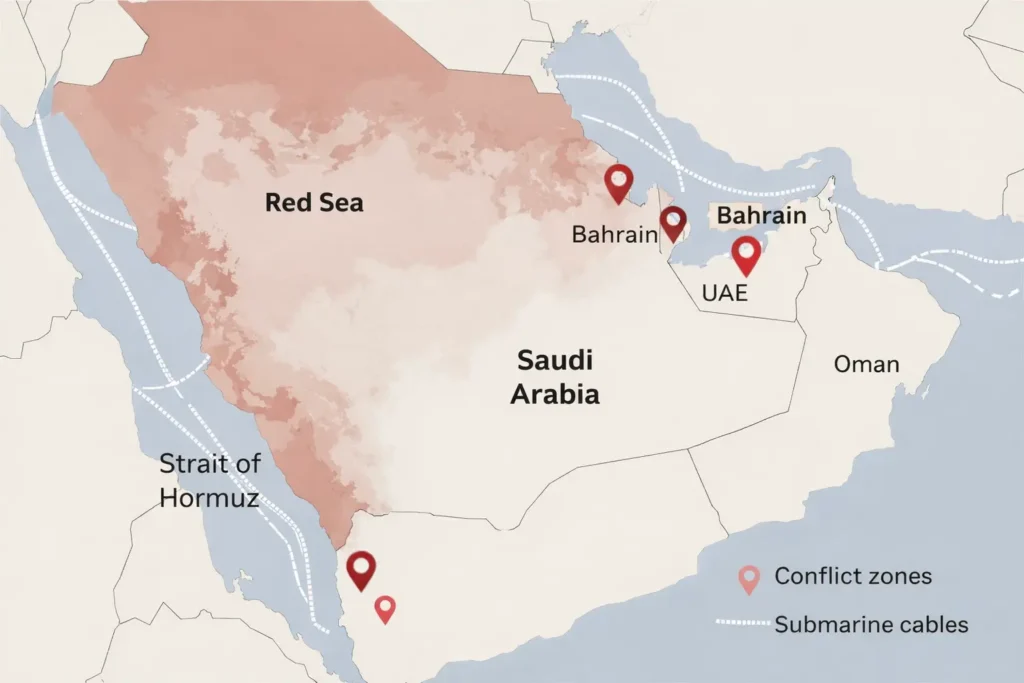
- 🎯 Cloud infrastructure is now a physical war target — Iran struck three AWS data centers in UAE and Bahrain, knocking them offline in what analysts call the first deliberate military strike on commercial cloud facilities in history.
- 🤖 AI was inside the war machine — The U.S. military was running Anthropic’s Claude on AWS for live intelligence assessments, target identification, and battle simulations during the Iran strikes.
- ⚔️ The civilian-military cloud boundary no longer exists — Pentagon war networks and your banking app run on the same physical servers. Attacking one now means attacking both.
- 🏗️ Data center security was never built for drones — Cooling units, generators, and turbines sit fully exposed. You don’t need to hit a server hall to take an entire facility offline.
- 🌊 Two global internet chokepoints are in the firing line simultaneously — 17 submarine cables through the Red Sea and the Strait of Hormuz are both inside active conflict zones — a scenario with no historical precedent.
- 💰 The Gulf’s $2 trillion AI boom now carries a war premium — Stargate UAE, Amazon’s $10B+ Saudi investments, and every hyperscaler expansion in the region must now factor in aerial attack as a live operational risk.
- 🚨 Nobody was prepared — and the clock is ticking — Senior officials worldwide were not thinking about these risks systematically. Analysts unanimously call these strikes the beginning of a pattern, not the end of one.
The cloud has an address — and Iran just hit it
Three Amazon Web Services data centers were struck by Iranian drones and missiles last week — two in the UAE, one in Bahrain. The attacks knocked critical facilities offline and disrupted banking, payments, delivery apps, and enterprise software across the Gulf region. What makes this moment historically significant isn’t just the scale of the disruption. It’s what these facilities were quietly running: AI models, including Anthropic’s Claude, used by the U.S. military for intelligence assessments and battle simulations.
Why data centers became military targets overnight
For years, the tech industry treated “the cloud” as something abstract — diffuse, borderless, untouchable. That framing was always a comfortable fiction. Data centers are physical buildings. They sit on land. They have GPS coordinates. And as of last week, they have confirmed drone strike coordinates too.
The attacks on AWS infrastructure mark what analysts believe is the first deliberate targeting of commercial data centers in an active armed conflict. But the conditions that made this possible have been building for years.
The U.S. Department of Defense runs its Joint Warfighting Cloud Capability and its Joint All-Domain Command and Control (JADC2) networks — systems that coordinate military operations across every domain — on commercial cloud infrastructure. The same servers processing your ride-hailing app or your bank transfer are, on another partition, processing military logistics and intelligence workloads.
Iran’s state news agency Fars News said on Telegram that the Bahrain facility was deliberately targeted to expose its role in supporting “the enemy’s military and intelligence activities.” AWS has declined to comment. Whether U.S. military workloads were disrupted remains unconfirmed — but the intent behind the strikes is now a matter of public record.
This is what analysts call the dual-use problem: when commercial infrastructure serves military functions, every attack on commercial infrastructure is, potentially, a military strike.
The five fault lines this attack just exposed
1. AI is now embedded in active military targeting chains
Multiple news organisations reported that the U.S. military used Anthropic’s Claude — hosted on AWS — for intelligence assessments, target identification, and battle simulations during the Iran strikes. This is not a future scenario. AI models running on commercial cloud infrastructure were part of a live military operation. That makes the underlying data centers legitimate targets under the logic of modern warfare.
2. Physical security was never built for aerial threats
Data centers have long invested in perimeter security: fences, biometric access controls, CCTV. None of that stops a drone. More critically, these facilities depend on exposed external infrastructure — cooling units, diesel generators, and gas turbines — that can be disabled without a direct hit on the server halls. “If you knock out some of the chillers you can take them fully offline,” Sam Winter-Levy, a fellow at the Carnegie Endowment for International Peace, told the Financial Times.
3. The Gulf’s AI ambitions now carry a security premium
The attacks land at a particularly sensitive moment. President Trump’s Gulf tour last May generated over $2 trillion in investment pledges, including the planned Stargate UAE campus in Abu Dhabi — which would be the largest AI facility outside the United States. Amazon separately committed $5 billion to an AI hub in Saudi Arabia. Those investments now carry a strategic security dimension that no one fully priced in at signing.
4. Two global data choke points are simultaneously at risk
Seventeen submarine cables run through the Red Sea, carrying the majority of internet traffic between Europe, Asia, and Africa. With Iran’s closure of the Strait of Hormuz and renewed Houthi activity in the Red Sea, both critical data corridors are now in active conflict zones at the same time. “Closing both choke points simultaneously would be a globally disruptive event,” Doug Madory, director of internet analysis at network intelligence firm Kentik, said. “I’m not aware of that ever happening.”
5. No one has been systematically thinking about this risk
Zachary Kallenborn, a PhD researcher at King’s College London who co-authored a study in the journal Risk Analysis on globally critical infrastructure, told Fortune that in conducting his research he held conversations with senior officials around the world and found that “basically no one is thinking about these risks in a systematic way.” That gap between the strategic reality and institutional preparedness is, arguably, the most alarming finding to emerge from last week’s strikes.
What this means for the AI industry — and everyone who depends on it
If you follow the AI space closely, you understand that the infrastructure race has been the defining story of 2025 and 2026. Hyperscalers are pouring hundreds of billions into new data center capacity. Governments are competing to host that capacity. The Gulf, with its cheap energy, sovereign wealth, and strategic geography, seemed like an obvious winner.
Last week complicated that calculus significantly.
The commercial cloud market was valued at over $670 billion in 2024 and is projected to exceed $1.2 trillion by 2028. A meaningful portion of that growth was anchored in Middle East expansion. The strikes don’t reverse that trajectory — but they introduce a risk variable that enterprise customers, insurers, and regulators will now have to price explicitly.
Chris McGuire, an AI and technology competition expert who served on the National Security Council under the Biden administration, told the Guardian that data centers in the Middle East may need to consider missile defense systems as part of their security architecture. That’s not hyperbole. It’s an operational planning question that AWS, Microsoft Azure, and Google Cloud will now face directly.
Read Also – Free AI Tools for Real Estate Agents: Zero-Cost Toolkit (2026 Guide)
The broader concern extends to any region where geopolitical instability intersects with data center density. As we covered in our deep-dive on AI infrastructure vulnerability and state-sponsored cyber warfare, the attack surface for critical AI systems is expanding faster than the security frameworks designed to protect them.
What organisations running cloud workloads should do right now
If you’re an enterprise, a developer, or a technology leader with production workloads in the Gulf region — or anywhere adjacent to active conflict zones — this is the moment to run a hard audit.
Practical steps to take in the next 72 hours:
- Map your geographic dependencies. Which AWS, Azure, or GCP regions host your critical workloads? Do you have automatic failover configured across regions outside the conflict zone?
- Review your SLA and force majeure clauses. Most cloud provider SLAs exclude war and acts of terrorism. Last week’s outages may not trigger contractual compensation.
- Test your disaster recovery plan. When did you last simulate a full regional outage? If the answer is “not recently,” schedule it this week.
- Brief your board or executive team. Geopolitical infrastructure risk is no longer a theoretical scenario to include in annual risk registers. It’s a live operational issue.
- Monitor submarine cable status. Tools like TeleGeography’s cable map and Kentik’s internet analysis dashboards provide real-time visibility into routing disruptions.
One specific question worth asking your cloud architect right now: “If our primary region went dark for 72 hours with no warning, what would break first — and do we have a tested fallback?”
Known limitation: multi-region failover is not automatic for most enterprise workloads. It requires deliberate architecture and comes with cost and latency trade-offs. Do not assume redundancy exists unless you have tested it.
What comes next — and what to watch
The strikes on AWS infrastructure will almost certainly accelerate two parallel conversations that were already gaining momentum.
First, governments will face pressure to establish clearer legal frameworks around the status of commercial AI infrastructure in armed conflict. Does a data center running military AI qualify as a legitimate military target under international humanitarian law? That question has no settled answer today.
Second, expect major cloud providers to revisit their physical security architectures in high-risk regions — potentially including partnerships with defense contractors for air defense integration. Whether that crosses a line the tech industry is comfortable with is a question the industry hasn’t publicly confronted yet.
Winter-Levy’s assessment is worth taking seriously: physical attacks on data centers “are only going to become more common moving forward as AI becomes more and more significant.” The Gulf strikes are, in his words, “a harbinger of what’s to come” — and explicitly not limited to the Middle East.
Three things this attack changed permanently
The line between commercial cloud and military infrastructure is now officially gone — not blurred, gone. Any cloud facility running dual-use AI workloads should be treated as a potential strategic target by adversaries with aerial strike capability.
Physical security for data centers needs a complete rethink. Perimeter fencing and access controls were never designed for the threat environment that now exists.
The Gulf’s AI infrastructure boom will continue — but the security calculus has fundamentally shifted. Investors, enterprises, and governments will need to price geopolitical risk into every data center decision from this point forward.
If you manage cloud infrastructure or make technology investment decisions, bookmark this page — we’ll update it as new details emerge on the AWS outage scope and the U.S. military’s response to the targeting of its AI workloads.
What’s your organisation doing to harden its cloud infrastructure against regional disruptions? Share your approach in the comments.
🔗 EXTERNAL AUTHORITATIVE LINKS
🏛️ Government & Policy Sources
1. U.S. Department of Defense —
2. U.S. Cybersecurity & Infrastructure Security Agency (CISA)
3. Fortune
Author Bio
Mayank Srivastava covers AI infrastructure, national security technology, and the geopolitics of the cloud. They have tracked data center developments and state-sponsored cyber threats across 40+ countries since 2015.